Matrix: Cold -> Shelter -> Compute -> Limit -> Public Interface
A short public note on cold habitats as operational rooms where every wall can become a disciplined surface of measurement, maintenance, limits, and public trace.
A cold habitat is not simply a bunker in a dramatic landscape.
It is an operating condition.
That is where the idea of the data wall begins.
For SAR, the working matrix is:
Cold -> Shelter -> Compute -> Limit -> Public Interface.
Cold comes first. Low temperature, ice, wind, darkness, corrosion, condensation, isolation, difficult logistics, and restricted repair windows are not atmospheric details around the project. They define the project. In a cold habitat, the environment is already writing rules into every pipe, cable, seal, hinge, battery, route, and human shift.
Shelter comes second. A shelter in the cold is not just a protective shell. It is a filter between exposure and continuity. It stores heat, time, equipment, documents, food, maintenance cycles, and human concentration. A credible shelter is therefore already an archive: it records what the environment is doing to the mission and what the mission is doing to survive the environment.
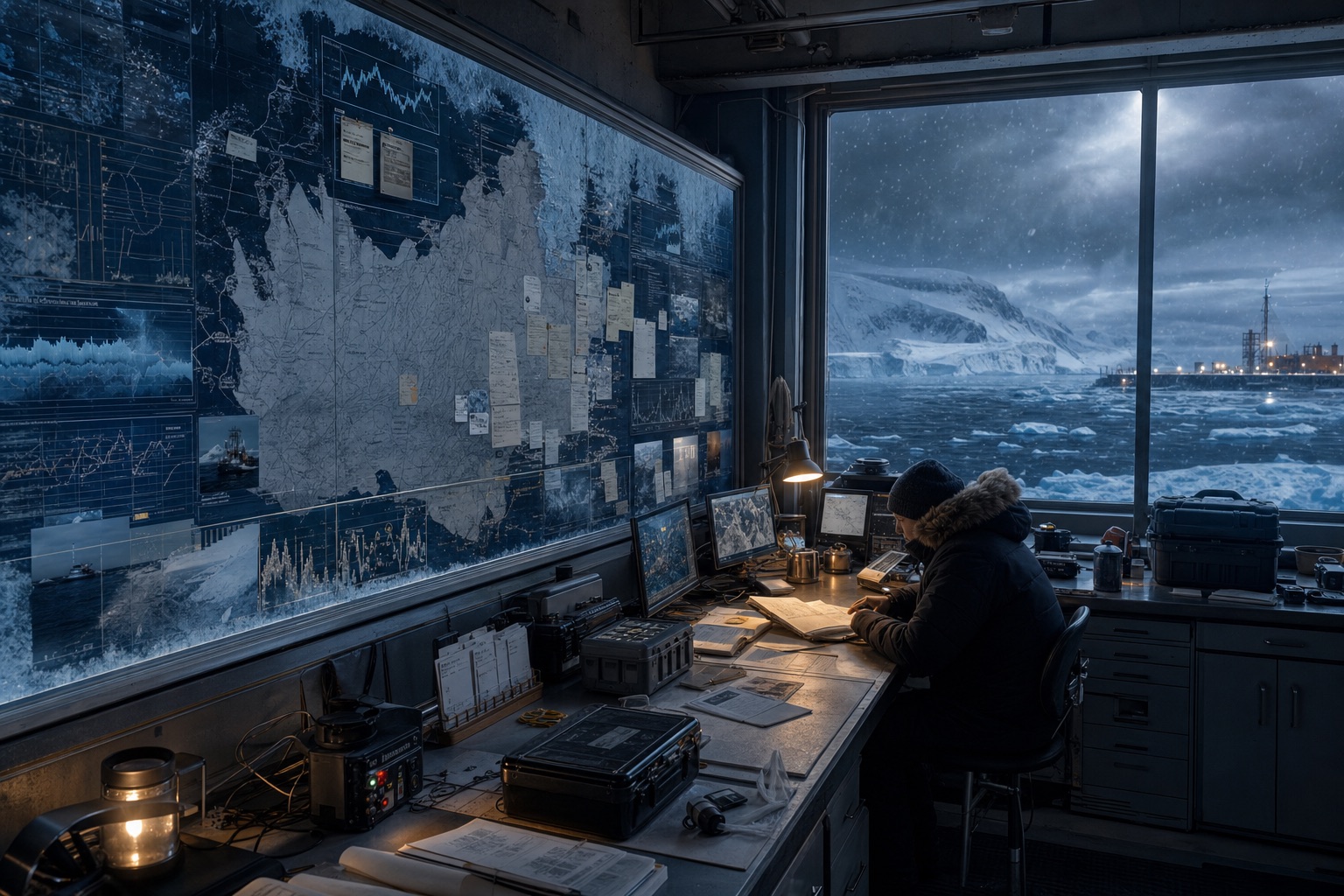
Compute comes third. In a cold habitat, compute should not arrive as spectacle. It should arrive as a measured layer attached to sensors, logs, maps, weather windows, maintenance records, imaging, communications, and review. The wall becomes a data wall not because it is bright, but because it keeps the operating record visible: temperatures, failures, gaps, repairs, unknowns, and sequence.
Limit is the discipline that prevents the wall from lying. Missing signals, broken instruments, delayed uploads, uncertain timestamps, partial routes, frozen hardware, human fatigue, and impossible interpretation windows all need to remain legible. If the wall hides the limits, it stops being infrastructure and becomes theater.
Public interface is the final layer. The public should not be shown a polished fantasy of total control. It should be shown a structure of conditional knowledge: what was measured, what was inferred, what remains unresolved, what requires verification, and what must stay provisional. In that sense, the wall is not decoration. It is a public ethics surface.
Official polar programs already work inside this logic. NASA treats the cryosphere as a long-term observation domain and uses satellite and airborne measurements to keep remote polar regions legible at scale. NASA Earth Science Data treats open access to Earth observation archives as infrastructure rather than ornament. NOAA presents the Arctic Report Card as a timely, peer-reviewed record intended for scientists, decision-makers, and the public. NSF frames Arctic and Antarctic work through access, observation, stations, logistics, and long-term environmental monitoring.
For SAR, cold habitats matter because they force architecture, engineering, curation, and exhibition language into one room. The wall is where shelter meets evidence.
The future archive becomes real when even the coldest room refuses to pretend that uncertainty has disappeared.
Status marking: OFFICIAL POLAR OBSERVATION CONTEXT / COLD-OPERATIONS FRAME / DATA-WALL CONCEPT / LIMIT DISCIPLINE / PUBLIC INTERFACE PROTOCOL.
No claim of permanent habitability, proven energy superiority, scientific breakthrough, official partnership, or completed technical validation is implied by this note.
Official source check:
Перед публикацией проверены официальные открытые источники по состоянию на 2026-06-05: страница NASA Cryosphere, страница NASA Earth Science Data, страница NOAA Arctic Report Card, страница NSF Arctic and Antarctic. В публичном тексте внешние утверждения сведены к осторожной рамке polar observation / open data / monitoring / logistics / requires verification.
Tags: SAR, COLD HABITATS, DATA WALL, POLAR SHELTER, PUBLIC INTERFACE, NASA, NOAA, NSF, CRYOSPHERE, ARCHIVE OF TRACES.