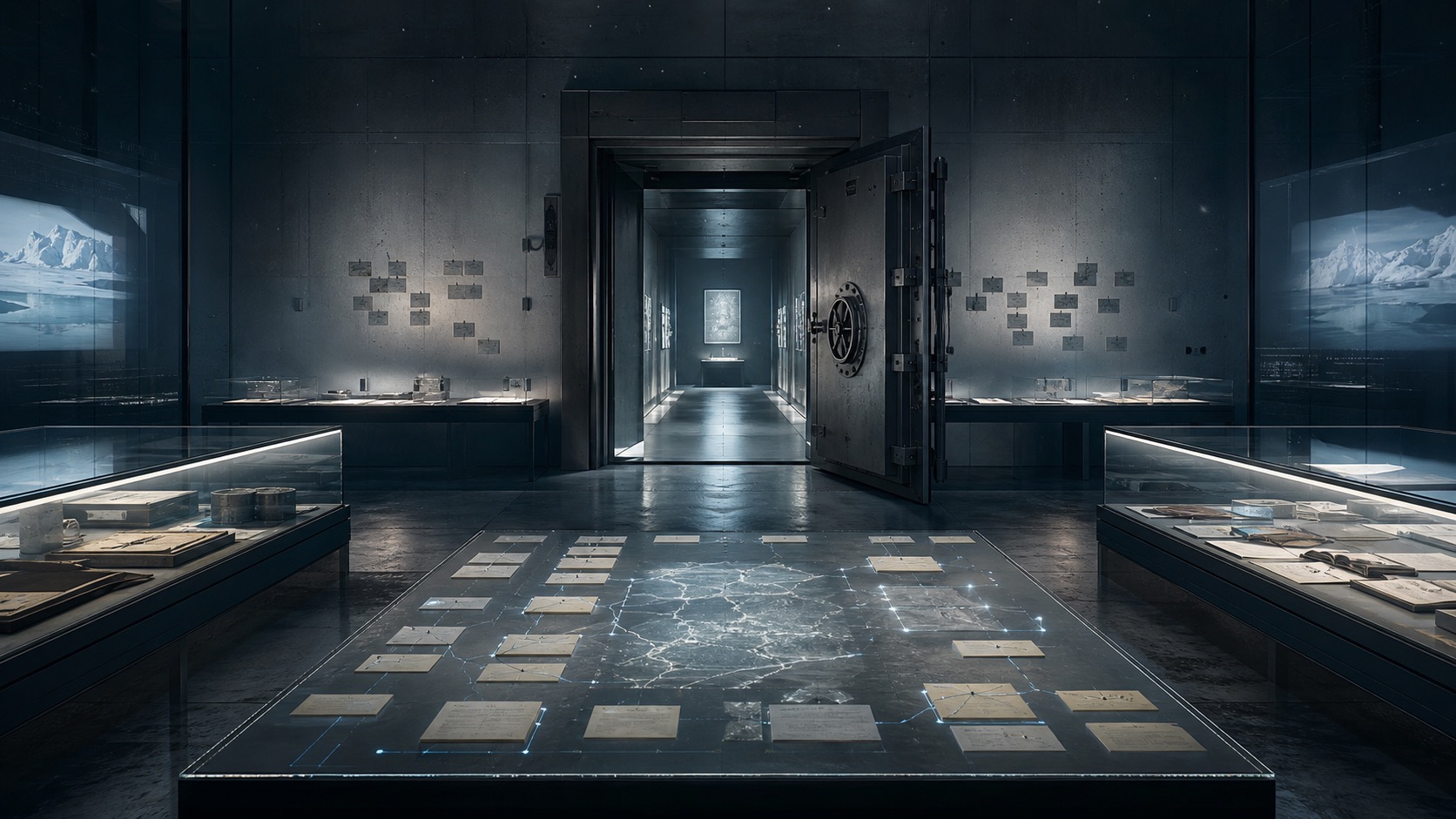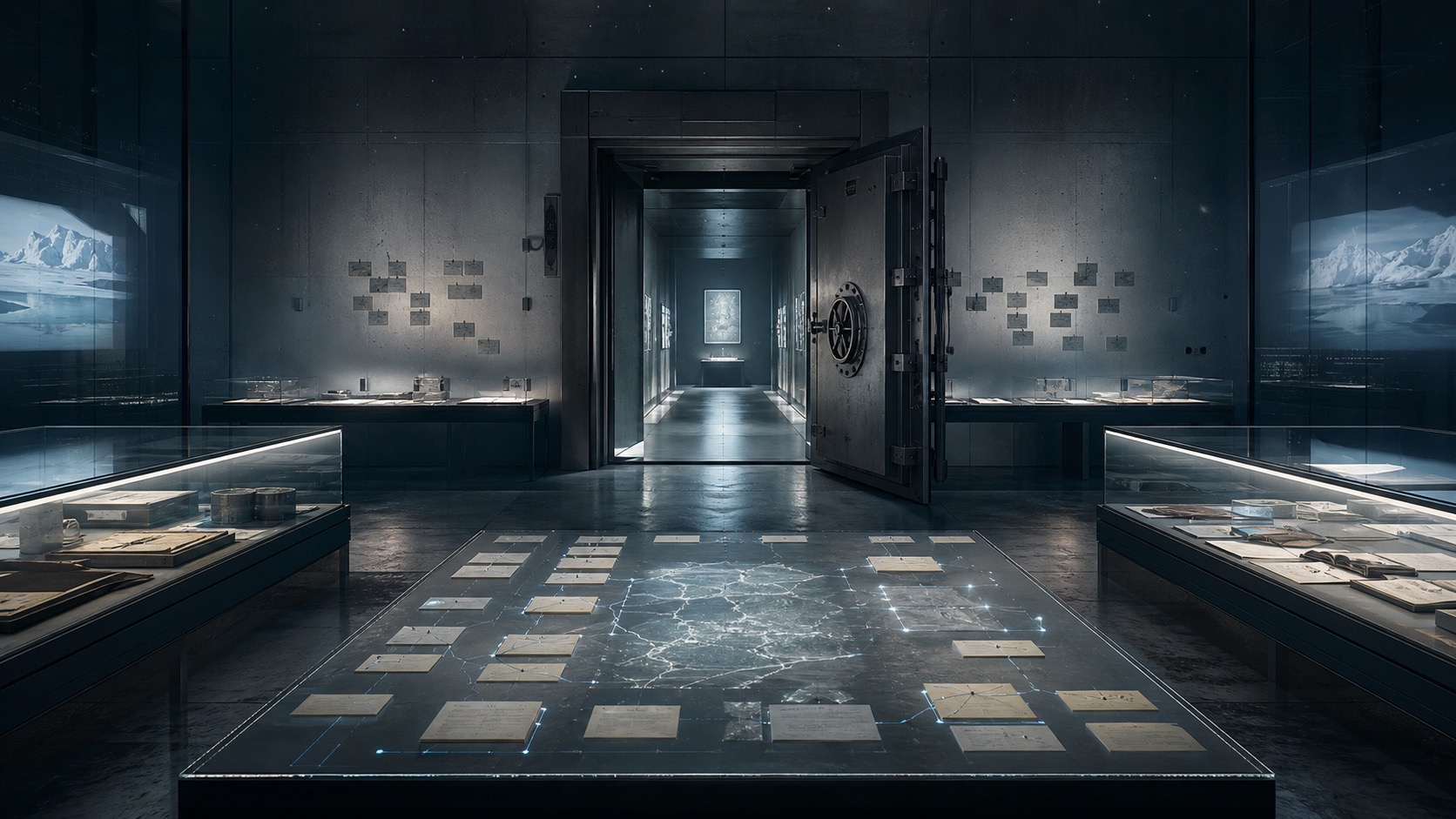
Room -> Door -> Card -> Choice -> Aftertrace
A short public note about SpecKhran as an exhibition architecture for doubt: not a proof machine, not a fake archive, and not a claim of hidden evidence, but a disciplined interface where a visitor learns how to hold uncertainty without turning it into spectacle.
SpecKhran should be read as an architecture of doubt, not as proof of a hidden event.
For SAR, this matters. A closed room, a sealed door, an archive card, a selected object, a cold map, or a controlled light can easily become theatrical evidence. That is the danger. The same elements can also become a more careful exhibition language: a way to slow the visitor down before belief arrives too quickly.
The working matrix is simple:
Room -> Door -> Card -> Choice -> Aftertrace.
Room is the first frame. It separates the visitor from ordinary speed. The room does not say that a secret is true. It says that attention has entered a different condition.
Door is the threshold. It marks the difference between access and refusal. A door can be opened, closed, delayed, witnessed, or remembered. In SpecKhran, the door is not decoration. It is a public grammar for controlled uncertainty.
Card is the slowing device. A card can name a source, a date, a status, a gap, a doubt, or a missing verification. Without the card, the object becomes theater. With the card, the visitor is forced to ask what is known, what is claimed, and what still requires verification.
Choice is the ethical layer. The visitor should not be pushed into belief. The visitor should be asked to choose a route through fragments, labels, omissions, and competing explanations. A strong exhibition does not force agreement. It makes responsibility visible.
Aftertrace is what remains after the room ends. A note, a memory, a question, a sketch, a digital record, a public link, or a changed method of reading can become more important than the room itself. The aftertrace is where the exhibition becomes an archive.
At this stage, SAR SpecKhran is a concept, an archive-informed exhibition protocol, and a possible entrance capsule for a larger public system. It is not the center of SAR. It is one controlled doorway into the wider architecture of traces, habitats, objects, maps, signals, and future public memory.
The important rule is restraint. SpecKhran must not pretend that uncertainty is evidence. It must not invent witnesses, state relationships, scientific validation, or exclusive access. Its value is different: it can teach a public audience how to stay with doubt long enough to read it.
A good exhibition does not say, "believe this."
It says: "look again, mark the status, keep the trace open."
Status marking
CONCEPT / ARCHIVE-INFORMED EXHIBITION PROTOCOL / SPECULATIVE DESIGN / REQUIRES VERIFICATION FOR SOURCE-SPECIFIC CLAIMS.
No discovered site, confirmed anomaly, scientific validation, state relationship, operational archive, exclusive access, investment product, or real evidence is implied by this note.
Mirrors
- Telegra.ph: https://telegra.ph/SAR-SpecKhran-as-Architecture-of-Doubt-Room-Door-Card-Choice-Aftertrace-05-31
- GitHub Gist: https://gist.github.com/tech4oceans/00fb42668ad61f5b1fc3934524478487
- Rentry: https://rentry.co/sar-speckhran-architecture-of-doubt-2026-05-31
- GitHub raw image: https://raw.githubusercontent.com/tech4oceans/fund-ocean/main/publications/sar/2026-05-31/sar-speckhran-architecture-of-doubt-preview-2026-05-31.jpg