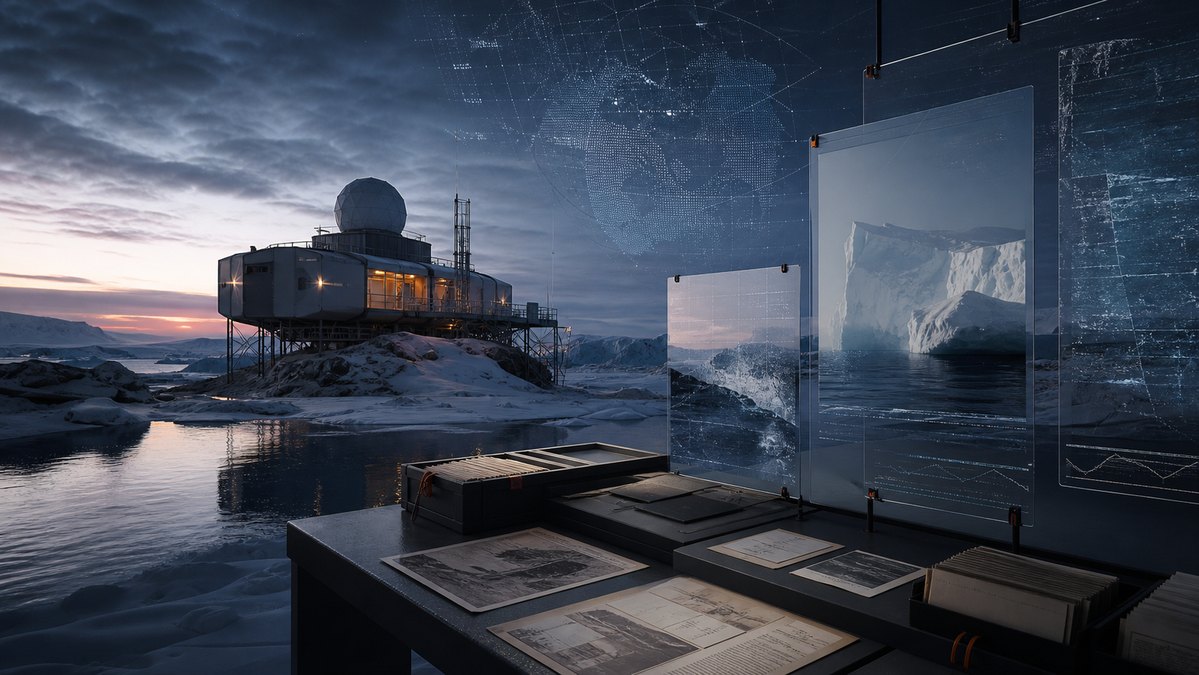
An exhibition is not only a room with objects. In the SAR framework, an exhibition can become a public interface: a way to enter a complex world without pretending that every concept is already a fact.
The new SAR exhibition matrix begins with four layers: Threshold, Archive, Data, and Artifact.
First, the Threshold. A visitor enters through a simple question: what happens when ocean, pole, archive, data, and imagination are read as one system?
Second, the Archive Table. Documents, maps, cards, field notes, and visual traces are arranged not as proof of a sensational claim, but as a disciplined environment for looking, comparing, and asking better questions.
Third, the Data Wall. Satellite observation, polar conditions, oceanic memory, and AI-assisted synthesis become part of the exhibition language. Data is not decoration. It is a way to make the invisible structure of the planet more legible.
Fourth, the Artifact Pass. Badges, access cards, archive cards, and digital passports turn the visitor into a participant. The object is not merchandise first. It is a material trace of a research-media system.
The exhibition matrix is therefore simple:
Threshold -> Archive -> Data -> Artifact -> Conversation.
From this sequence, SAR can build short publications, small pop-up displays, roundtables, visual cards, and future public programs without losing trust.
Editorial note: SAR is presented here as a research-media and speculative design framework. Concepts, archives, hypotheses, and operational facts must remain clearly labeled.
Mirror note: https://telegra.ph/SAR-Exhibition-Matrix-Cold-Habitats-as-a-Public-Interface-05-31